


Overview
Pokémon TCG Pocket is a card game published by The Pokémon Company, and it exists to handle card games, from solitaire to competitive collectible play. That framing matters more than any feature list: the useful question is not how much this game can do, but whether it does that one job in a way you can rely on when you are distracted, in a hurry, or on a poor connection.
This review works from what can be verified — the store listing, the category it competes in, and the rating it has accumulated — and is explicit about where judgement replaces fact.
Shuffle fairness and the cost of a competitive deck
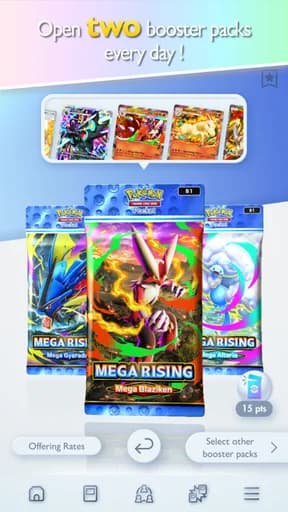
What matters in Card is narrower than a feature list suggests, and it is where Pokémon TCG Pocket should be measured first. In solitaire and similar games the question is whether deals are genuinely random or quietly tuned to produce near-misses. In collectible games it is what a competitive deck costs, in money or in months.
Both come down to the same thing: whether the game is honest about the odds. Pack rates, deal generation, and matchmaking are all places where the maths is either published or hidden.
What the rating actually tells you
Its 4.7 average sits at the top of what mobile software realistically achieves. Scores in this range usually indicate that the core task works reliably and that updates have not disrupted long-standing behaviour.
Store rating counts for Pokémon TCG Pocket are not recorded in this catalogue, so treat the average as a directional signal and check the current figure on the official listing.
How it compares within Card
Pokémon TCG Pocket rates almost exactly at the Card median of 4.7, placing it 4th of the 8 card titles tracked here. The category leader on rating is Solitaire - Classic Card Games, which is the most direct comparison worth making before settling on this one.
On audience size, Disney Solitaire leads the category with roughly 826.8K ratings. A smaller audience is not a defect — it often accompanies a more specific design — but it does mean fewer edge cases have been found by other people first.
Permissions, data, and account requirements
Collectible games involve real payments and disclosed odds in many jurisdictions. Purchase history is retained and used for offer targeting.
Most of what this category collects is used to make the product function. Even so, it is worth confirming what is retained after you stop using it, and whether deleting your account actually deletes the content.
Availability across stores
Pokémon TCG Pocket is listed on both Google Play and the App Store. Cross-platform availability is convenient, but feature parity is not guaranteed — release timing, platform-specific features, and pricing frequently differ between the two versions.
One detail worth noting: Google Play files it under Card, while the App Store lists it under Games. That kind of split usually means the game sits between two use cases, and it is a useful hint about which audience each store thinks it is for.
Notifications and attention
Notification defaults are set to maximise engagement, not usefulness, and Pokémon TCG Pocket is unlikely to be an exception. The first thing worth doing after installation is opening the notification settings and turning off everything that is not time-sensitive.
The signal to watch for is whether Pokémon TCG Pocket separates categories of notification or offers a single on-off switch. Fine-grained control is a reasonable proxy for whether the developer expects you to stay in control of the relationship.
Updates and long-term maintenance
Update cadence is the most useful maintenance signal available on a store listing. Check the last-updated date on the official page: a long gap in an actively-used category usually means the product is in maintenance rather than development.
The other side of frequent updates is disruption. Interface changes arrive without warning and cannot be declined, which is worth weighing before something becomes load-bearing in your routine.
Behaviour on a poor connection
Mobile software is used in lifts, on trains, and in buildings with unreliable signal, and that is where design quality becomes obvious. The question for Pokémon TCG Pocket is what remains usable when the connection degrades rather than disappears entirely — a partial connection produces worse failures than no connection at all.
The behaviour worth checking specifically is whether an action you have already taken survives. Losing a half-completed form, a queued message, or an unsaved change to a dropped connection is the failure people remember, and it is entirely preventable.
How to evaluate it yourself
For solitaire, watch whether unwinnable deals are flagged. For collectible games, price a top-tier deck before your first purchase and decide whether the number is acceptable.
Do this while you can still walk away easily. The cost of switching rises quickly once an account, a library, or a month of history is involved.
Verdict
Pokémon TCG Pocket suits players who want to know the odds before spending. The rating supports that, though the store listing remains the authority on current pricing, permissions, and regional availability.
Test the free experience first, keep only the notifications you actually want, and compare it against one alternative in the same category before it becomes the default.
Highlights
- Deal generation that appears genuinely random
- Published odds on paid packs
- Matchmaking that accounts for collection strength
- Rated 4.7 on Google Play
Limitations
- Competitive decks can be expensive
- Offer targeting follows spending behaviour
- Free-tier progress can slow sharply
Frequently Asked Questions
What is Pokémon TCG Pocket used for?
Pokémon TCG Pocket is a card game from The Pokémon Company, intended for card games, from solitaire to competitive collectible play. Shuffle fairness and the cost of a competitive deck is the part of the experience that most affects whether it works for you day to day.
Is Pokémon TCG Pocket free?
Pricing, subscriptions, and in-app purchases vary by country and release, and can change between versions. Open the official store listing from this page to confirm the current terms before installing.
What permissions does Pokémon TCG Pocket need?
Collectible games involve real payments and disclosed odds in many jurisdictions. Purchase history is retained and used for offer targeting. The store listing carries the authoritative, current permission list for your region.
Where can I download Pokémon TCG Pocket?
This page links only to verified official listings — Google Play and the Apple App Store. Find Good Apps does not host or distribute application files.
How should I test Pokémon TCG Pocket before relying on it?
For solitaire, watch whether unwinnable deals are flagged. For collectible games, price a top-tier deck before your first purchase and decide whether the number is acceptable.
Does Find Good Apps develop Pokémon TCG Pocket?
No. Find Good Apps is an independent publication operated by Sophon LLC. It is not the developer, publisher, or distributor of Pokémon TCG Pocket, and has no commercial relationship with The Pokémon Company.